
Since 1 January 2026, outpatient medical services are no longer billed with TARMED. They are billed with TARDOC, the new fee-for-service tariff structure, supplemented by outpatient flat rates for certain treatments. For a practice, the change is concrete: new positions, new rules, and software to update. Here are the essentials.
This guide gives an overview. For the detailed rules, refer to the official publications of the tariff organisation and of your cantonal medical association.
Why TARMED was replaced
TARMED came into force in 2004. In twenty years, outpatient medicine has changed a great deal: new techniques, new models of care. The structure no longer kept pace, and its values no longer reflected the time actually spent on many services.
TARDOC was developed to describe outpatient medicine as it is practised today. On 30 April 2025, the Federal Council approved the new outpatient tariff structure, made up of TARDOC and the outpatient flat rates, to come into force on 1 January 2026. It is managed by the outpatient medical tariffs organisation (OTMA SA).
What does not change
Fee-for-service billing remains the principle for most consultations in the practice. Each position corresponds to tariff points, and the point value is still set by canton. The patient still receives an itemised invoice.
What changes for a practice
New positions. The nomenclature is entirely new. The familiar TARMED positions no longer exist as such: for each service, you need to find the corresponding TARDOC position.
Flat rates for certain treatments. Some services are no longer billed position by position, but through an outpatient flat rate.
Documentation that has to keep up. The invoice must be backed by what is in the record: what was done, and why.
Up-to-date software. Your practice software must incorporate the new structure to produce compliant invoices.
How Aida helps
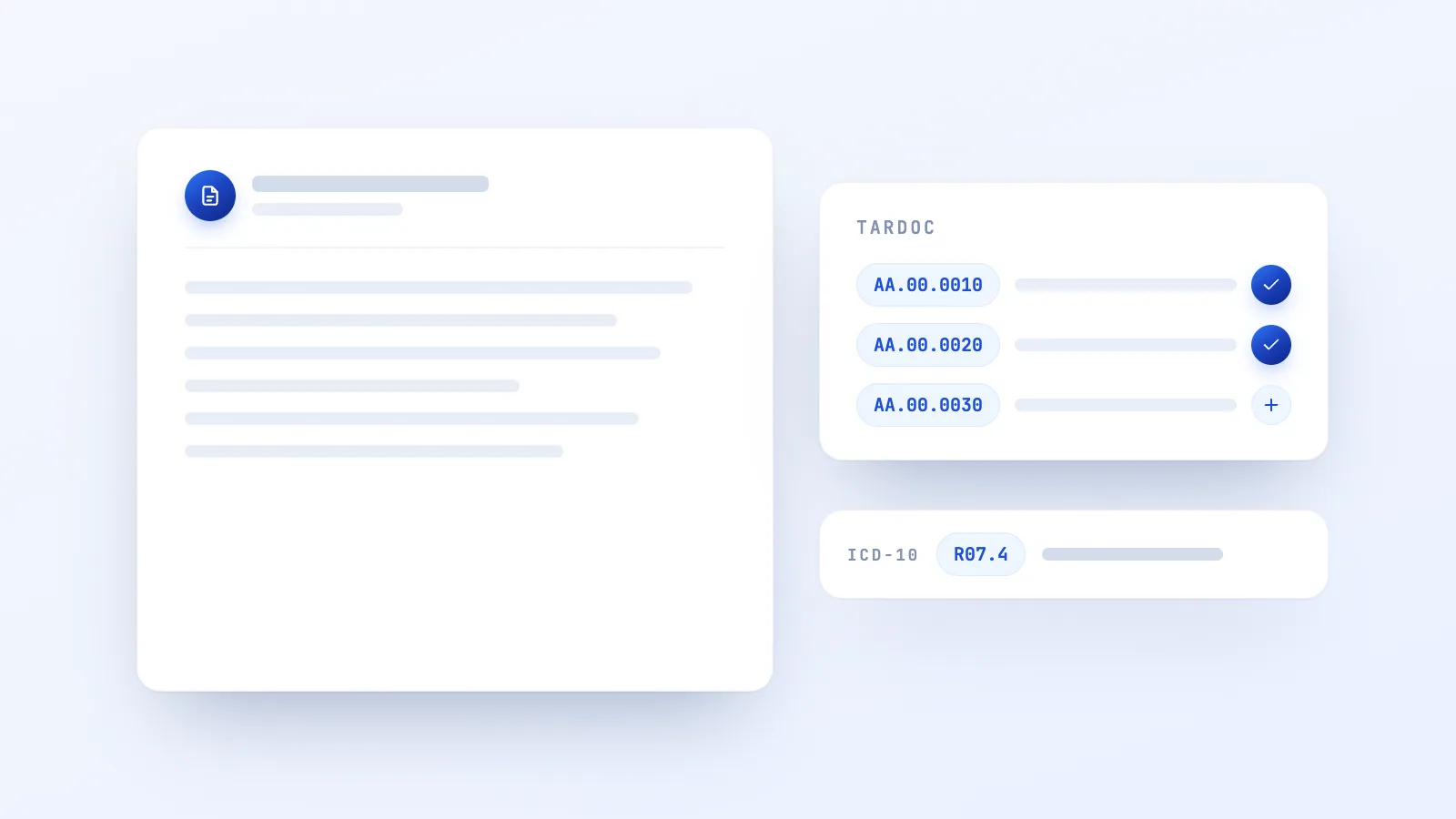
Aida MD suggests TARDOC positions from the content of the consultation, alongside the note and the ICD-10 diagnoses. You see the suggestions next to the note, you correct or accept them, and they go into your practice software along with everything else.
Aida does not bill anything on your behalf: it prepares, you approve. The aim: no more searching for a position in the nomenclature, just checking a suggestion that matches what was said.
Further reading
- the Federal Office of Public Health (FOPH) page: TARDOC and outpatient flat rates;
- the publications of the outpatient medical tariffs organisation (OTMA SA);
- your cantonal medical association and the FMH;
- your practice software vendor, for the tariff structure update.
To see how Aida MD suggests TARDOC positions during the consultation: the Aida MD page.